
News analysis ·
Miners Lift Bitcoin Output as Power Costs Squeeze Margins
HIVE and MARA grew quarterly Bitcoin production but reported lower mining revenue as rising electricity expenses squeezed margins across the sector.
Major Bitcoin mining operators expanded physical coin output over the September quarter even as lower market valuations and rising power bills eroded revenue, according to quarterly reporting from Cointelegraph. The contrasting figures highlight how post-halving economics and elevated industrial electricity rates continue to test treasury reserves and operating efficiency across the mining industry.
The Production and Revenue Divide
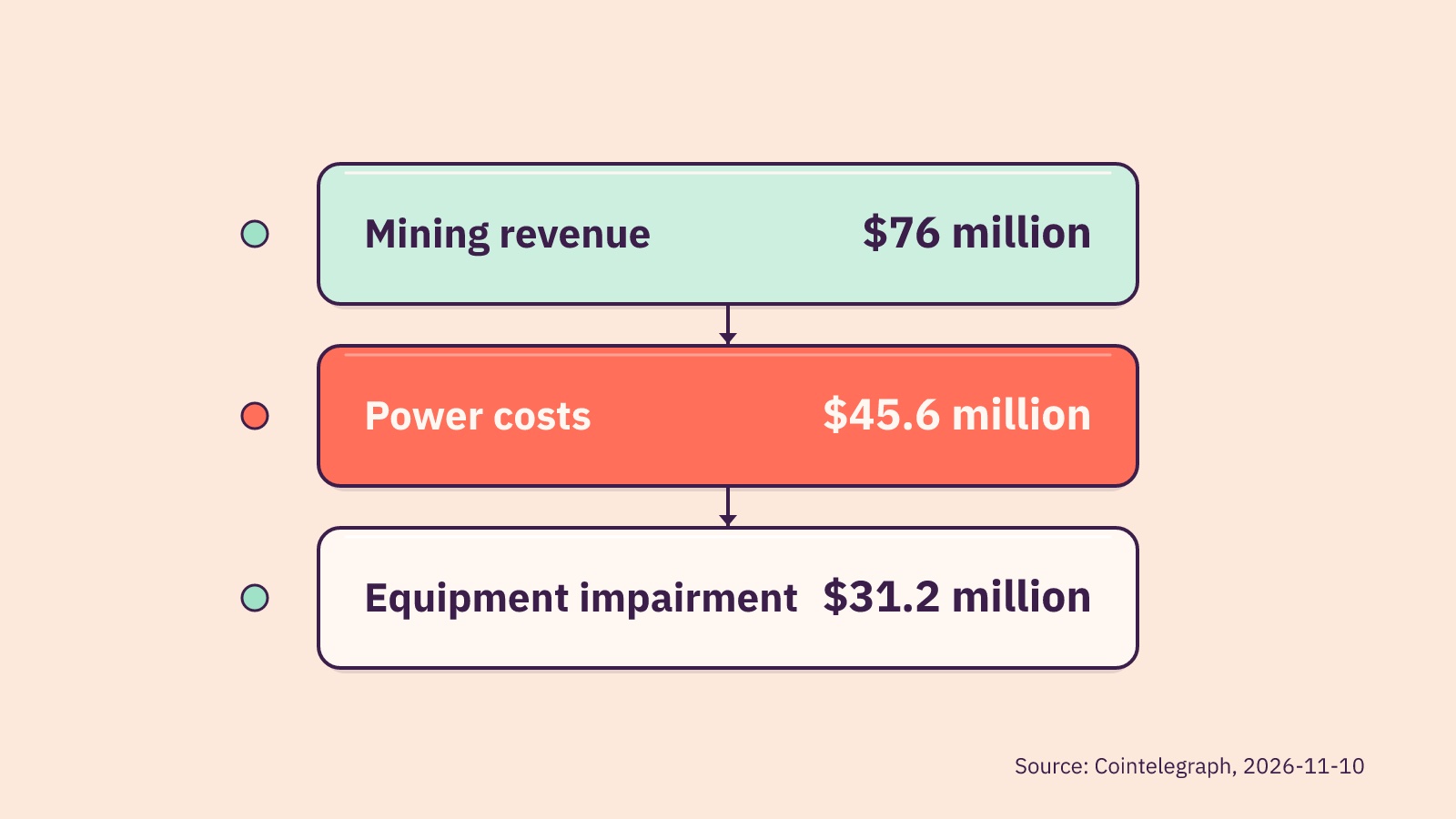
Cointelegraph reported that HIVE increased its quarterly coin production by 49% to reach 1,070 Bitcoin. Despite higher production volume, HIVE reported mining revenue contracted 7.4% to $76 million. MARA recorded a 5% increase in mined output, generating 2,247 BTC over the quarter, yet its Bitcoin mining revenue declined 34% to $159 million over the same operating period.
Balance-sheet maneuvers followed the compressed operating margins. Following the quarter ended Sept. 30, MARA sold 13,597 BTC for approximately $1.1 billion. The company applied $750 million from the sale proceeds to fully settle its Bitcoin-backed term loans, an action that released 17,477 BTC previously pledged as collateral back into unencumbered custody.
Rising Power Bills and Equipment Impairments
Operational costs across North American facilities expanded alongside higher hash computation. HIVE experienced a 20% surge in electricity expenditures, reaching $45.6 million, while purchased power costs at MARA advanced 12% to $48.1 million as owned operations scaled.
Diminished hardware efficiency prompted accounting writedowns across both companies. HIVE recorded an impairment of $31.2 million against equipment balances due to depressed unit margins, while MARA took an impairment charge of $12 million across mining rigs tied to restructuring initiatives. Pressures have forced structural shifts across the broader competitive landscape, with industry peer Core Scientific announcing intentions to exit digital currency mining by year-end.
How Hashrate and Difficulty Drive Mining Economics
A miner's gross revenue depends on network difficulty, block subsidies, and transaction fee capture:
When global computing competition increases, individual rigs yield fewer sats per petahash, requiring operators to continuously deploy more energy-efficient silicon or risk operating below direct power breakevens.
- Block subsidy issuance halves periodically on a scheduled protocol timetable.
- Network difficulty adjusts periodically to ensure average block intervals remain near ten minutes.
- Electricity tariffs represent the primary continuous cash outflow for industrial facilities.
- Capital allocation shifts toward alternative computing when artificial intelligence contracts yield higher margins per megawatt.
High-Performance Computing and Data Center Pivots
To insulate balance sheets from mining cycles, operators are actively repurposing electrical interconnects toward enterprise computing. Hosting revenue from high-performance computing at HIVE expanded 71% to $8.8 million, delivering 10.4% of total revenue. HIVE allocated up to $493 million across 36 months to build out artificial intelligence computing infrastructure, with capital deployments toward data center expansion totaling $145.3 million at filing date.
Facility retrofits and international power agreements remain central to these strategies. HIVE designated $35 million to convert its Toronto property into a Tier-III data facility. In Paraguay, HIVE targets adding 100-megawatt substation capacity at the Yguazú site during 2026.
What It Means for Network Fees and Difficulty
For everyday users transferring value across the network, miner compression has kept transaction costs historically modest. Live network desk data at block height 975,618 shows Bitcoin trading at $70,606.00 with quiet mempool conditions. Next-block transactions clear at 3 sat/vB, pricing a standard simple send at $0.30 for a 141-vbyte send at 3 sat/vB.
Lower hash revenue may soon trigger a downward difficulty adjustment. With a 3-day average hashrate running at 956 EH/s, the next difficulty adjustment estimate indicates a reduction of -8.14%, projected 126 blocks away. A downward adjustment lowers unit production costs for remaining active rigs.
Next on the Network Desk
Key network milestones to monitor across upcoming sessions:
- 126 blocks remaining until the estimated -8.14% difficulty adjustment.
- Next halving at block 1,050,000, currently 74,382 blocks away or about 517 days at 10 minutes a block.
Sources
- Cointelegraph, 10 Nov 2026
Drafted by AI from the sources listed above and published automatically after software checks (figures matched to sources, no copied sentences); not edited by a person. Educational content only, not buy or sell advice.